
Custom Wedding Dress Cost Factors in Portland
There is no single price for a custom wedding dress in Portland. At Stephanie Mai, every gown is designed and made by hand in our Portland studio, and the final price is quoted after a design consultation. It reflects four things: the fabric you choose, the lace, beading, and embroidery details, the construction complexity, and the time your timeline allows. A simple gown in a straightforward fabric costs less than an elaborate gown with hand-stitched lace and beading — and we work with you to stay within your budget.

Hand-stitched lace and beading is one of the four factors that set a custom gown’s price.
The four things that set the price
Every custom gown is unique, so the price is set gown by gown. These are the four factors your quote is built from.
1. Fabric selection. Fabric is usually the largest material cost in a gown. A silk crepe or an imported lace costs more than a simple synthetic, and the same silhouette in an imported silk can cost substantially more in fabric alone than in a plainer cloth. Yardage matters too — a full skirt or a long train simply uses more fabric. We choose the fabric together, after the design is set.
2. Lace, beading, and embroidery. Handwork is priced by the hours it takes. An elaborate embellishment of hand-stitched lace or beading costs more than a gown with simple details — the single clearest price step in a custom gown. Scattered appliqué, a fully beaded skirt, or embroidery across a train each add hours of skilled work. If you love the look but need to hold the budget, we can concentrate the detail where it shows most — the bodice and the train — and keep the rest clean.
3. Construction complexity. A simple sheath is quicker to build than a gown with a boned corset bodice, multiple lining layers, a built-in petticoat, and a layered skirt. Every structural element — boning, cups, linings, a bustle, a cathedral train — adds pattern work, fittings, and sewing time. Two gowns that look alike in a photo can be quoted very differently — what matters is how the gown is built, not only how it looks.
4. Timeline requirements. A gown made on a comfortable schedule costs less than the same gown made in a rush — short timelines compress the work, can require rush fabric orders, and leave no room to absorb a delay. Our timeline from concept design to finished gown is up to 6–10 months, depending on the design's complexity and the number of fittings needed. Starting early leaves room for fabric to be sourced without rush orders, lets fittings happen at a normal pace, and gives us time to solve a design problem properly rather than expensively. Across the wider market, rush orders commonly carry fees of 15–50% of the base price.

What ‘custom’ means at Stephanie Mai
A custom dress is made specifically for you, taking into account your body shape, your personal style, and the theme of your wedding. Our designer works with you at every step: we start with a clear sketch so you can preview the design before production, then select the fabric together. A mock-up is ready for your first fitting, which lets us perfect the fit and make revisions before we sew the actual fabric. The designing and production all take place in our design studio in Portland.

A mock-up fitting lets us perfect the fit before cutting the final fabric.
Custom vs. off the rack: the total-cost picture
Comparing a custom quote with a boutique price tag is not quite comparing like with like. An off-the-rack gown is usually priced before alterations, accessories, undergarments, and preservation — across the market, those extras commonly add $500–$1,500 beyond the gown itself. A custom gown is built to your measurements from the start, so the fit work is part of the commission, not a separate bill. Customizing is often more budget-friendly because it prevents unexpected alteration costs, reduces wasted work, and gives you a clearer price from the start.
What the wider market charges
Broad market context — published figures from other sources, not Stephanie Mai pricing. We do not publish gown prices; every gown is quoted after a design consultation.
The Knot's 2026 Real Weddings Study: the average American bride spent about $2,100 on her gown, mostly off the rack or made to order.
Published custom-atelier guide ranges (Dressarte Paris, 2026): made-to-order $1,500–$3,000; made-to-measure $2,500–$5,000; fully bespoke $3,500–$10,000+; luxury couture $10,000–$25,000+.
Portland, locally: Ania Bridal lists designer dresses typically at $1,800–$7,000+; Wedding Report's Portland-metro estimate puts the average wedding dress at $1,926–$2,354.
The only way to know your number at Stephanie Mai is a design consultation — the four factors above are what your quote is built from.
How to get your price
Book a design consultation at our Portland studio: $65 for one hour, or $75 for 1.5 hours (a fitting consultation is $45). At the consultation we talk through your design, your fabric, and your budget, and your final price is quoted after that conversation. Design begins once we have agreed a contract and received payment. To start, email steph@stephaniemai.com or book an appointment. Our studio is at 127 NE 6th Avenue, Portland, OR 97232 — phone 503-819-4512.
Frequently asked questions
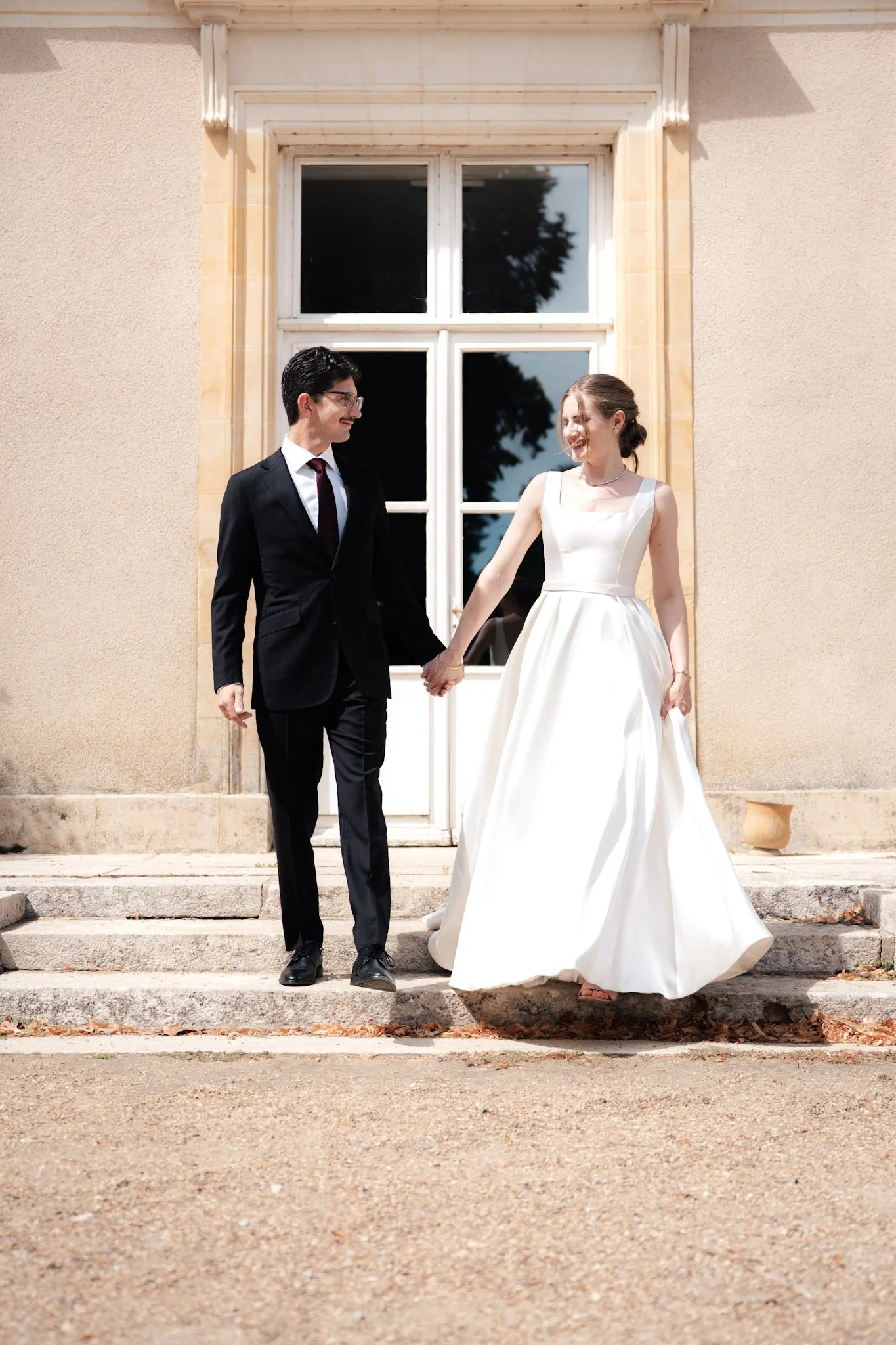
Madeleine & Romain
-
There is no single price. At Stephanie Mai, every gown is designed and made by hand in our Portland studio, and the final price is quoted after a design consultation. It reflects four factors: fabric, lace, beading and embroidery, construction complexity, and timeline. A simple gown costs less than an elaborate one with hand-stitched lace and beading, and we work with you to stay within your budget.
-
Not necessarily. An off-the-rack price usually excludes alterations, accessories, and preservation, which commonly add $500–$1,500. A custom gown is built to your measurements, so the fit work is part of the commission — customizing is often more budget-friendly because it prevents unexpected alteration costs and gives you a clearer price from the start.
-
Our timeline from concept design to finished gown is up to 6–10 months, depending on the design's complexity and the number of fittings needed. Start well in advance — early starts protect your budget and leave room for fabric sourcing and unhurried fittings.
-
We talk through your design, fabric, and budget. Our designer works with you from a clear sketch, so you can preview the gown before production, and your final price is quoted after the consultation. A design consultation is $65 for one hour or $75 for 1.5 hours.
-
Yes. Tell us your budget at the consultation and we will work with you to stay within it — adjusting the fabric, concentrating handwork where it shows most, or simplifying construction — so together we can create your dream dress.